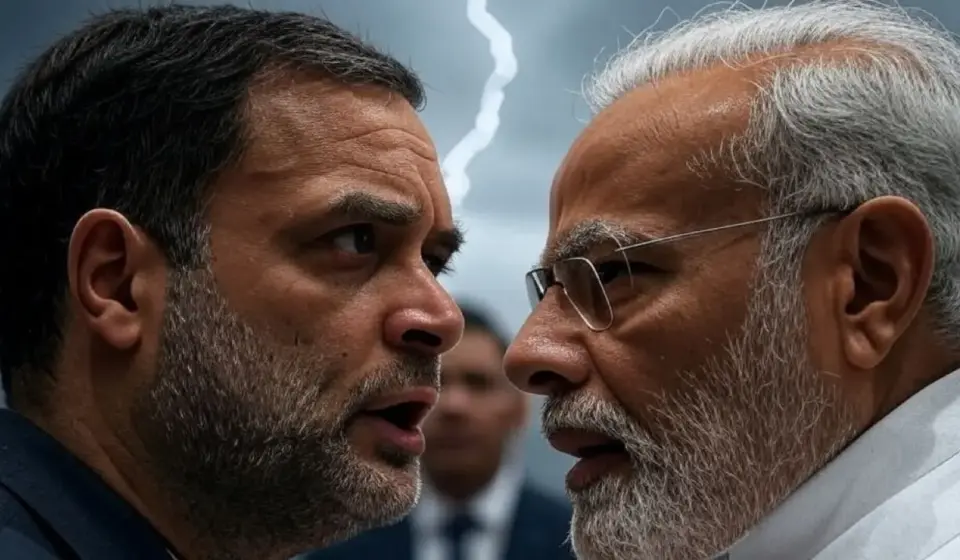
BJP furious over Rahul’s ‘economic tsunami’ statement, why is it silent on questions from economic experts

The Bharatiya Janata Party (BJP) has responded to Lok Sabha Opposition Leader Rahul Gandhi’s warning of an “economic tsunami.” The BJP called it “classic fear-mongering” and urged Rahul Gandhi to stop panic-mongering. While the BJP is politically countering Rahul Gandhi, it remains silent on questions raised by economic experts. Former Finance Secretary Subhash Chandra Garg, economic experts Dr. Surjit Bhalla and Rajesh Mahapatra, among others, have raised serious questions about the government’s economic policies, but the government has not directly addressed their questions.Leader of the Opposition and Congress MP Rahul Gandhi has repeatedly stated that India is heading towards an “economic tsunami.” A video of him in this regard went viral on social media on Thursday, June 4. He alleged that the BJP government has removed India’s safety net (shock absorber) from the international economy. Rahul said, “A dangerous economic tsunami is coming. Prices are rising and this is just the beginning.”
Three key points of Rahul Gandhi’s statement
Claim of Economic Tsunami: Rahul Gandhi alleged that the government’s economic policies (such as unemployment, inflation and alleged favouritism to select industrialists) were pushing the country towards a major economic crisis, which he termed as an ‘economic tsunami’.
Prediction of Government Fall: He claimed that there are internal differences within the current coalition government (NDA) and that this government will fall within a year due to its contradictions.
Fear of Emergency: Rahul Gandhi also alleged that the Modi government may create an undeclared or declared ‘Emergency’ situation in the country to suppress the growing public anger and the voice of the opposition.
BJP hits back: “Rahul Gandhi should stop panic-selling”
The BJP completely rejected Rahul Gandhi’s claims, calling them an attempt to create instability in the country. The main arguments of BJP leaders are as follows:
Politics of ‘fear and confusion’: The BJP says that Rahul Gandhi lacks any concrete policy options, so he is creating fear and confusion (panic selling) among the public.
Strong economic data: Citing global rating agencies and the country’s GDP data, the BJP said that India is one of the fastest-growing major economies in the world. Therefore, talk of an ‘economic tsunami’ is completely imaginary.
Attack on Emergency: The BJP countered by reminding that the actual Emergency in India (1975) was imposed during the Congress government, and the current Modi government is working within the ambit of the Constitution.
What are economic experts saying?
An article by former Finance Secretary Subhash Chandra Bose has been published. He writes that the weak economic situation that Prime Minister Modi and his ministers have been taunting for 13 years under the UPA government has not improved under the Modi government; instead, the situation has become “fragile.” That is, the situation has worsened. He cites Morgan Stanley’s “Fragile Five” report and India’s poor economy. In 2013, Morgan Stanley listed India, along with Brazil, Indonesia, South Africa, and Turkey, as one of the “Fragile Five.” This was the time when the Indian rupee suffered a significant decline following the US Federal Reserve’s “taper tantrum” policy. This decline has now reached a record low of nearly 97 rupees per dollar.Garg has written that Morgan Stanley, which has been a supporter of the Modi government’s policies for at least seven years, has not moved up the list of ‘Fragile Five’ since last year. Subhash Chandra Garg, in an article written in the Deccan Herald newspaper, has said that India has now moved from the list of ‘Fragile Five’ countries to ‘Vulnerable One’, meaning ‘unsafe’ or ‘delicate’. Garg has written, “Prime Minister Narendra Modi and his ministers have been criticizing the UPA government by labeling it ‘Fragile Five’ for 13 years. But what is the condition of the Modi government itself now?”
What did Surjit Bhalla write about the Indian economy?
Subhash Chandra Garg wrote that five countries, including India, were previously referred to as the “Fragile Five.” Economist Surjit Bhalla, considered a supporter of the Modi government, has now downgraded this to “Fragile Two,” which includes India and Turkey. Renowned economist and former IMF Executive Director Surjit Bhalla recently made several important and outspoken remarks about the state of the Indian economy, GDP growth, and the rupee.It was generally believed that the Indian economy slowed due to the Middle East military conflict that began in February 2026 and rising oil prices. However, Surjit Bhalla dismissed this view, stating: The main reason for the economic slowdown is not the global crisis, but rather a lack of private investment within the country. Private sector investment has declined rather than increased. He argued that until a few months ago, strong GDP figures and low inflation rates were creating an illusion that “everything is rosy.” According to him, this growth rate was primarily driven by government spending and investment. Bhalla argues that private investment is much more efficient than government spending. Government infrastructure projects are prone to corruption and offer lower returns than costs.
The rupee should strengthen, but policies are getting in the way.
Regarding the rupee’s historic decline, Bhalla said that India’s economic fundamentals (such as a low current account deficit and controlled inflation) favor a strengthening of the rupee, not a weakening. However, this is not happening due to: Policy Uncertainty: The lack of clarity in India’s economic policies has shaken investor confidence. India has very high tax rates on foreign investors. He cited the example of efforts to develop GIFT City into an international financial hub, which has failed to achieve the desired results because capital gains taxes remain high there. However, on Thursday, June 4th, the Modi government abolished the captive gains tax on government bonds for FPIs. Changes in bilateral investment treaties since 2015 have led to foreign capital preferring to leave India (e.g., Vietnam or Bangladesh) rather than come to India.